Puzzle
—
00:00
Progress
Paused
Kakuro is a crossword made of numbers. Fill every white cell with a digit from 1 to 9 so that each run adds up to its clue, and never repeat a digit within a run. This free Kakuro game has 500 puzzles from easy to expert plus a new daily Kakuro, and each one is verified to have exactly one solution.
Put one digit from 1 to 9 in every white cell. Zero is never used.
The number above a diagonal is the sum of the run going across. The number below it is the sum of the run going down.
A digit can appear only once within a run. A sum of 4 in two cells is 1+3, never 2+2.
The full rules with a solved example and the game controls.
Twelve techniques, from unique sums to area sums.
Every digit combination for every sum and run length.
History, difficulty levels, daily puzzles and more.
Type in any Kakuro grid and solve it, or look up every combination for a sum.
Print puzzle sheets at any level, with an answer key.
Kakuro, also called Cross Sums, is a number logic puzzle played on a grid like a crossword. You fill each white cell with a digit from 1 to 9 so that every horizontal and vertical run adds up to the clue beside it, and no digit repeats inside a run. A well-made Kakuro has exactly one solution, so you can solve it by logic alone, without guessing.
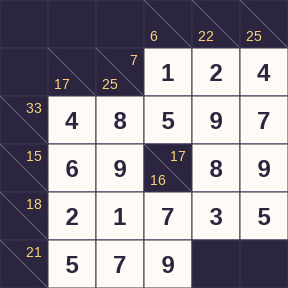
Kakuro and Cross Sums are the same puzzle with the same rules. It first appeared as Cross Sums in Dell puzzle magazines in the United States around 1950. The Japanese publisher Nikoli later named it kasan kurosu (“addition cross”), which was shortened to Kakuro, and that name spread worldwide in the 2000s. Some puzzle books also call it Sum Totals. Read more in the short history of Kakuro.
There are four levels. Easy Kakuro puzzles use a 5×5 grid with short runs, so they suit beginners and kids who are new to Cross Sums. Medium Kakuro puzzles are 7×7. Hard Kakuro puzzles are 9×9, and Expert Kakuro grids are 11×11, with long runs and many crossings. Every puzzle can be solved by logic alone, so you never need to guess.
The daily Kakuro is the same puzzle for every player on the same date. It is easy on Mondays, medium from Tuesday to Friday and hard at weekends. Solve it on consecutive days to build a streak, or catch up on missed days in the daily archive.
Cross Sums is the original American name for Kakuro, so this is also a free Cross Sums game. It runs in any browser on a phone, tablet or computer, with no sign-up. You can add it to your home screen to use it like a Kakuro app, and it keeps working offline after your first visit.
Pencil notes, undo and redo, an optional mistake check and one-cell hints are all built in. The combination helper lists every digit set that fits the selected runs, much like a Kakuro cheat sheet that updates as you play. New to the puzzle? Read how to play Kakuro, then try the Kakuro tips and strategy guide.
These Cross Sums totals can be made with only one set of digits, so they are the best places to start any puzzle. The full Kakuro combinations chart lists every sum for every run length.
| Cells | Unique sums |
|---|---|
| 2 | 3 = 1+2 · 4 = 1+3 · 16 = 7+9 · 17 = 8+9 |
| 3 | 6 = 1+2+3 · 7 = 1+2+4 · 23 = 6+8+9 · 24 = 7+8+9 |
| 4 | 10 = 1+2+3+4 · 11 = 1+2+3+5 · 29 = 5+7+8+9 · 30 = 6+7+8+9 |
| 5 | 15 = 1+2+3+4+5 · 16 = 1+2+3+4+6 · 34 = 4+6+7+8+9 · 35 = 5+6+7+8+9 |
| 6 | 21 = 1+2+3+4+5+6 · 22 = 1+2+3+4+5+7 · 38 = 3+5+6+7+8+9 · 39 = 4+5+6+7+8+9 |
| 7 | 28 = 1+2+3+4+5+6+7 · 29 = 1+2+3+4+5+6+8 · 41 = 2+4+5+6+7+8+9 · 42 = 3+4+5+6+7+8+9 |
Stuck on a Cross Sums puzzle from a newspaper or a puzzle book? The free Kakuro solver solves any grid you type in and includes a combination calculator. If you prefer pen and paper, print Kakuro puzzles at any level, with the answers on a separate page.
Each dark clue cell gives a total. The white cells in the run next to it must add up to that total, using digits 1 to 9 with no repeats in the run. Every white cell sits in one run across and one run down, so each digit has to fit two sums at once.
Start with runs that can be made only one way, such as 3 in two cells (1+2) or 24 in three cells (7+8+9). Where two runs cross, keep only the digits both runs allow. When a run has one empty cell left, subtract the other digits from its clue. The step-by-step guide walks through a full example.
Kakuro usually feels harder at first, because you need to know which digits add up to each clue as well as follow the logic. Once the common sums are familiar, the two are similar, and both range from easy to very hard. Our easy Kakuro puzzles are a gentle place to start.
Yes. The unique sums above cover the most useful cases, and the free Kakuro combinations chart lists every digit combination for every sum from 2 to 9 cells. You can print it to use with puzzle books.
Yes. Cross Sums is the original American name used by Dell magazines, and Kakuro is the Japanese name from the publisher Nikoli. The rules are identical.
Yes. All 500 puzzles and the daily Kakuro are free to play in your browser with no sign-up or download. Your progress is saved on your own device.
Read the full guide →
Tip: some sums have only one combination. 3 in 2 = 1+2 17 in 2 = 8+9 6 in 3 = 1+2+3 Use the combination helper to spot them.